There was once an old lady who swallowed a fly…

Posted by Sam Lincoln

Biological systems are incredibly complex (see ecological networks blog). Introducing a spider to eat a fly may not help; New Zealand found that out the hard way with rabbits and ferrets. When one food source is running low, most predators prey-switch, and in New Zealand that often means moving onto our native birds. We regularly control rats both in our homes and local parks with little knowledge of the indirect impacts wrought upon biological systems. My Masters project aims to take a first look at how domestic cats respond to the removal of rats in local parks – are they eating more of our birds?

In Auckland Council’s local parks, a mix of native and introduced birds share their space with predators such as rats and domestic cats. There has been much recent debate about the impact of cats in New Zealand; while scientists agree that cats have negative impacts on our native species, the SPCA often has a far more cat-friendly view citing rodent control by domestic cats as potentially helping birds. Even politicians are involved in the cat debate, with Conservation Minister Maggie Barry in one corner fighting for kiwi versus Prime Minister John Key representing Moonbeam. My pilot study of 11 cameras set for two nights captured 14 individual cats in two local parks (as well as a few possums and an MSc student).
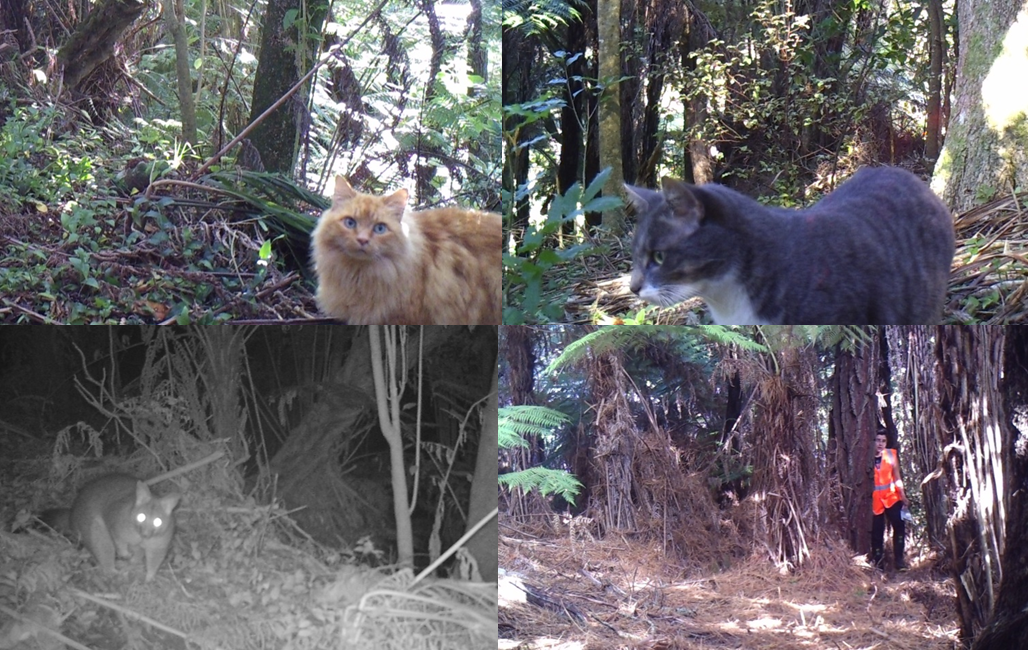
Photos from cat camera pilot study, clockwise from top left: two cats, MSc student Sam Lincoln and a possum. Cats were photographed visiting both parks during the day and night.

Photos from cat camera pilot study, clockwise from top left: two cats, MSc student Sam Lincoln and a possum. Cats were photographed visiting both parks during the day and night.

By assessing the changes to cat behaviour after removing rats from half of the sites, I will get a first look into what really goes on between cats, rats and birds – is rat control bad for birds due to increased predation by cats, or are rats the main culprits in an urban environment? What would happen if cats were to go? Should we instead be moving toward a predator free New Zealand where our birds can exist without either of these mammalian invaders?

Sam Ln web

Sam Lincoln is an MSc student in the Centre for Biodiversity & Biosecurity, School of Biological Sciences, University of Auckland. She is trying to disentangle interactions between domestic cats and rats in urban environments. She is supervised by Margaret Stanley, John Innes and Al Glen.

Marvel takes a risk with Ant-Man whilst I assess the risk of ants

Posted by Anna Probert @AFProbert

Ant-Man. The official superhero of 2015 and my PhD

Ant-Man. The official superhero of 2015 and my PhD

I have a feeling that my beloved study group are going to be gaining quite a bit of interest this year. I would love to say that it is a result of some ground-breaking research I have conducted, but alas. The true reason why I think 2015 is The Year of the Ant, is the impending release (that’s 16th July) of Marvel Studio’s Ant-Man. For those of you that are perhaps not on my level of Marvel fandom, Ant-Man is based on the comic of the same name, where the protagonist has the ability to shrink down to the size of an insect and has superhuman strength and agility. Although in my spare time I’m still trying to discover Pym Particles, my full time role involves being a PhD student here at the UoA and looking at assessing invasive species risk to native ecosystems, using ants as a model.

Unfortunately for our native environment, when it comes to exotic species arriving and establishing in New Zealand, we often let them slide by if they don’t have a perceived potential social or economic impact. As a result, we end up with exotic plant and animal species that become naturalised in the environment. How do they affect the environments in which they naturalise? Well in most circumstances, we don’t really know.

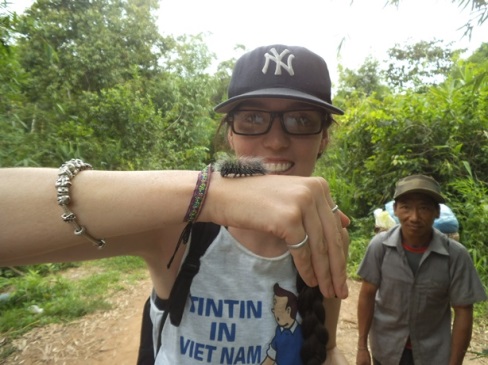
Out in the Hunua baiting for ants. Photo credit Luke McPake

Out in the Hunua baiting for ants. Photo credit Luke McPake

Here in New Zealand we have 29 established exotic ant species (compared to only 11 native species) and very little understanding of how they are influencing the environments in which they live. The Argentine Ant is the species most people would have heard of, as it is a well-known invader worldwide, causing various negative impacts on the environments in which it invades. But what of the other 28 established exotic species we have in New Zealand? What are they doing?

I don’t have the answers… yet, but for my PhD I’m specifically going to be looking at the ways exotic ants influence the invertebrate community structure within different ecosystems, as well as investigating their role in altering ecosystem function. This will involve conducting different manipulative field trials over the upcoming spring/summer seasons – and I’m always on the lookout for field assistants, so let me know if you want to spend a day in nature out with me and the ants.

P.S. Marvel Studios, I am indeed open to sponsorship.

AnnaAnna Probert is a PhD student in the Centre for Biodiversity & Biosecurity, School of Biological Sciences, University of Auckland. She is using ants as a model to assess the risk posed by exotic invertebrates to native ecosystems. She is supervised by Margaret Stanley, Jacqueline Beggs, and Darren Ward.

How To Host A Vegetarian Invader

Posted by Jessica Devitt @Colette_Keeha

Recently I just said goodbye to roughly 200 guests. They were not thankful for the hospitality I showed them, they sometimes disliked the meals I served, so much so that they would rather starve than eat, and when I showed them to their new living quarters they would vomit on me to show their disapproval. I still really liked them though. My guests were most probably from Australia, but their descendents are all over the world. Their full name is quite a mouthful, Henosepilachna vigintioctopunctata, but we are on a first name basis now, so I go with the more common ‘hadda’ beetle.

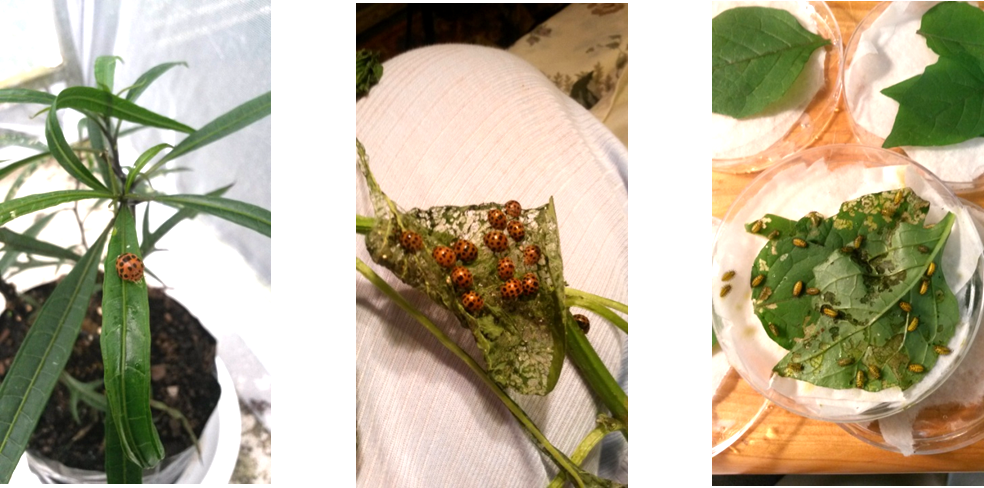
From left:  Enjoying an early lunch of poroporo, hanging together in pyjamas, and baby-sitting

From left: Enjoying an early lunch of poroporo, hanging together in pyjamas, and baby-sitting

The hadda beetle was first discovered in Auckland, New Zealand in 2010 and is a well known pest of a large range of crop species, like potatoes and tomatoes from the Solanaceae family. As part of my MSc, I’ve host-tested the beetles on some native New Zealand Solanaceous plants, like poroporo (Solanum aviculare). Many native New Zealand plants are in decline, and native Solanaceous plants, like poroporo, are important food sources for our fruit-eating bird species. Adding more pressures, like a Solanaceae-munching hadda beetle, could push them further into decline.

To test the beetle’s host range, I did a series of experiments that could not only tell us if the beetle would eat the plants, but more importantly, if the beetle could maintain a self-sustaining population on our native plants. I used the ‘no-choice’ host-testing method, where the beetle is confined to one type of plant and the ‘multi-choice’ test, which allowed the beetles to ‘choose’ to eat or oviposit on a plant from a range choices. Early results show that hadda beetles are indeed happy to munch away and lay eggs on NZ’s native solanums. But to what effect on our plant populations? Watch this space…..

jess Jessica Devitt is a MSc student at the Centre for Biodiversity & Biosecurity, School of Biological Sciences, University of Auckland. She is researching the potential host-range of the hadda beetle in Auckland to assess how it might impact on native ecology. She is supervised by Margaret Stanley

Married for 10 years – Centre for Biodiversity and Biosecurity

Posted by Jacqueline BeggsCBB logo

We all know marriage can be hard work – lots of fun and good outcomes when all goes well, but partners come with different experiences and expectations and compromise is usually needed. So it is when research institutes forge partnerships. The University of Auckland and Landcare Research jointly formed the Centre for Biodiversity and Biosecurity in 2005 to foster excellence & relevance in research and related postgraduate teaching.  So now it is time to celebrate 10 years of successfully working together with a 1-day symposium on Wednesday 1 July 2015, Owen Glenn Building, University of Auckland (city campus). All are welcome to attend, but please RSVP to c.warner@auckland.ac.nz for catering purposes. Our plenary speaker is Professor Mark Burgman, University of Melbourne, who will be speaking on “Problems and solutions in expert judgement of biosecurity risk”. And like any celebration of a long-term partnership – there’ll be plenty of good food and drink, and friends to share it with.

What we talk about when we talk about ecological networks

Posted by Carolina Lara @carislaris

I was recently asked by an engineer friend of mine what my PhD project was about. In my (failed) attempt to put it into simple words, I ended up giving him a large discourse on the topic. A couple of days passed and he got back to me to say “… I always thought biological systems were simpler”. I am new to this world of ecological networks, but simplicity is not a word that can be used to describe them. More specifically for animal-plant mutualistic networks, a set of animals interacts mutualistically with a set of plants that are connected to another set of animals that interact with another set of plants. Animals disperse a plant´s genes and get food as a reward, as in the case of pollination and seed dispersal ecosystem services.

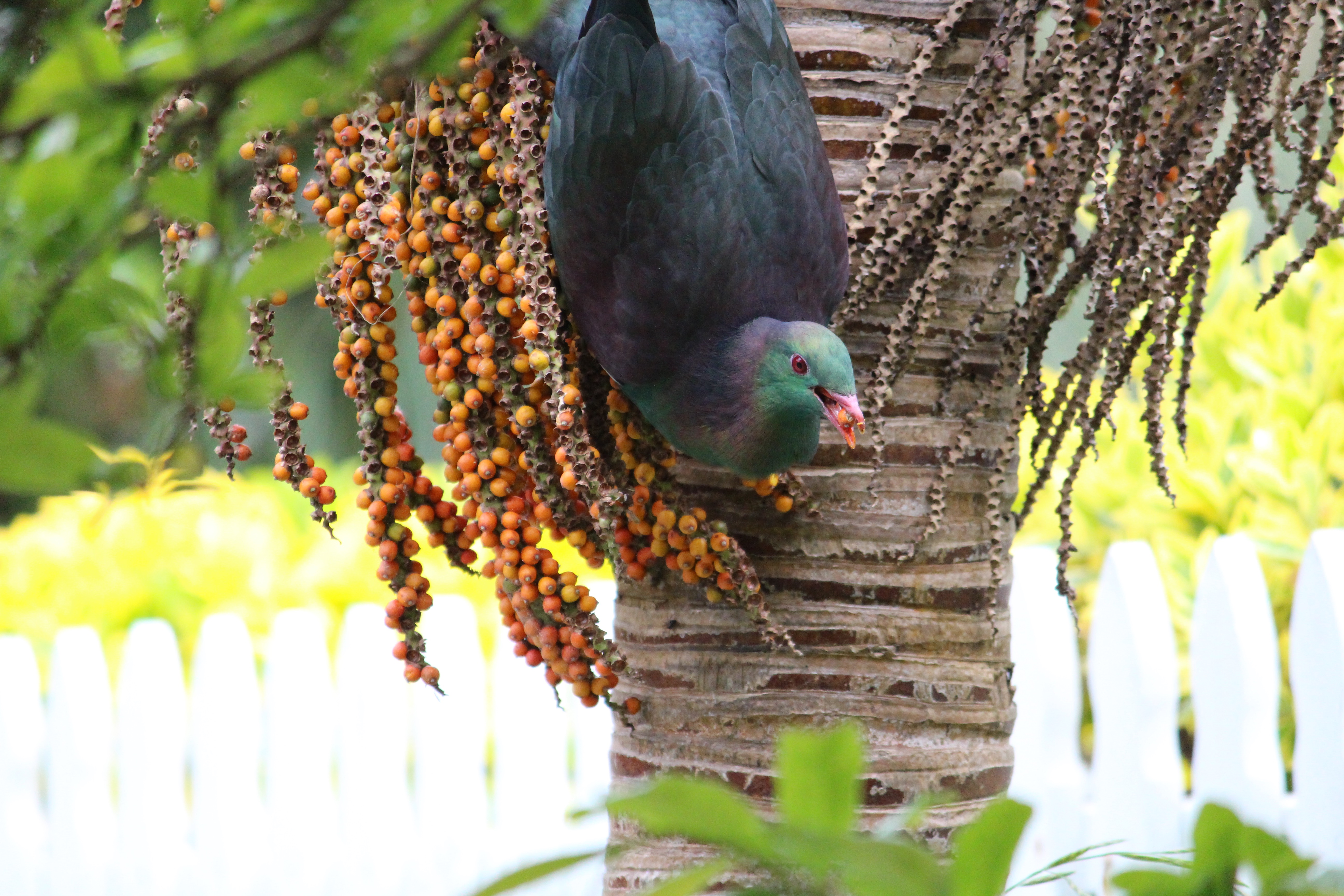
Kereru (Hemiphaga novaeseelandiae), New Zealand’s native pigeon, feeding on Nikau Palm (Rhopalostylis sapida) fruit

Kereru (Hemiphaga novaeseelandiae), New Zealand’s native pigeon, feeding on Nikau Palm (Rhopalostylis sapida) fruit

The dynamics of these networks and how they are built have profound implications on the coexistence of species and moreover, they can give us insights about how resilient they are to human disturbances, such as habitat fragmentation. It has now been recognised that conservation efforts should not only be directed to species alone, but should also be extended to the interactions and networks they form. Loss of interactions would translate into loss of ecological functions and this could happen even before actual species extinctions, a concept known as extinction debt of ecological interactions. Daniel Janzen, a pioneer scientist in tropical ecology, stated more than 40 years ago that “what escapes the eye, however, is a much more insidious kind of extinction: the extinction of ecological interactions”. So, we really are talking about complexity when we talk about networks. And I’m glad I changed my friend´s perception of just how complex biological systems are.

Carolina2Carolina Lara M. is a PhD Candidate within the Centre for Biodiversity and Biosecurity, School of Biological Sciences, University of Auckland. Her research interests focus on seed dispersal networks within fragmented landscapes. She is supervised by Margaret Stanley, Jason Tylianakis, Karine David, and Anna Santure.

SCIENCE NEEDS YOU!!

Posted by Alice Baranyovits @ABaranyovits

New Zealand's native pigeon, the kererū, are important seed dispersers as they swallow fruits whole.

New Zealand’s native pigeon, the kererū, are important seed dispersers as they swallow fruits whole.

Having spent a fair amount of time wandering around Auckland city with a large blue antenna, I have been stopped and asked what I am doing quite a bit. Whilst it was very tempting to tell people I was looking for aliens or just trying to get a good signal for my phone, I did eventually explain to them that I was radio tracking kererū (NZ pigeon; Hemiphaga novaeseelandiae).

Alice radio tracking kererū in urban Auckland.

Alice radio tracking kererū in urban Auckland.

On the whole, people seemed pretty interested and would often tell me about the kererū they see around the city.
This got me thinking, perhaps there was a way I could get people to record this information so I could get more of an understanding of where kererū were in the city and where they weren’t. So I created a website, imaginatively entitled ‘The Auckland Kererū Project’ as a platform where members of the public can record their sightings as well as information on the plants in their gardens.

The use of volunteers in research, also known as citizen science, has long been a tool of ornithologists and ecologists – the Audubon Christmas bird count in the US is one of the longest running having started in 1900. More recently the number of citizen science projects has been increasing, helped in part by the internet and the advancement of mobile technology, which has led to much easier data collection.

One of the main benefits of citizen science is that very large data sets can be collected often over a large geographical area and time scale, much larger than what could be collected by a single researcher. Data can also be collected from private land, removing the access issues researchers often face, especially in urban areas. Participants in citizen science can also benefit through increased knowledge and appreciation of the local biota and issues in their local community and through gaining an insight into the scientific process.

Alice is studying how kererū move around fragmented landscapes and more specifically how they utilise the urban environment.

Alice is studying how kererū move around fragmented landscapes and more specifically how they utilise the urban environment.

There are some drawbacks, however, that must be taken into account during data analysis. Participants often have variable skill levels which can lead to issues with data quality. Variations in sampling effort both in time and space can also be a concern. Despite these issues, citizen science is a great tool and is likely to become even more prevalent in the future.

Want to get involved? There are many citizen sciences projects in New Zealand – one of the largest is NatureWatch NZ, which listed many different projects you can get involved with. Or how about Landcare Research’s annual garden bird survey? But of course don’t forget about the Auckland Kererū Project!

Alice Baranyovits is a PhD student at the Centre of Biodiversity and Biosecurity, School of Biological Sciences, University of Auckland. She is researching the movements of kererū in urban areas and the implications on seed dispersal of native and introduced plants. She is supervised by Mick Clout, Jacqueline Beggs & George Perry.

What about the water? ‘Ecofriendly’ plantations will drink vast amounts of water

Margaret, Jacqueline and CatePosted by Cate Macinnis-Ng @LoraxCate

A government funding windfall to the Dryland Forest Initiative was reported in the NZ Herald today. The plan is to breed and grow drought adapted eucalypts in dry regions of the country with less than 1000 mm of rainfall per year.

Seems like an excellent plan. Eucalypts grow quickly, rapidly accumulating carbon in high quality wood. Even better, they are very comfortable in dry conditions. Sounds like a perfect ‘environmentally friendly’ product.

But what about the water cost? As I explain in this post, trees use vast amounts of water. A single tree can use over 2000 litres in a day and a stand of trees may use 90% or more of incoming rainfall. This means less water for other activities in the catchment including water required to maintain stream health. Eucalypts will exploit water resources as they become available with deep roots often accessing groundwater and physiological processes rapidly responding to rainfall events.

As droughts become more frequent, eucalypts are likely to remain healthy but they will use scarce water resources. Any plans for plantations or increases of woody vegetation in dry regions need to include a consideration of the impact on catchment water yield. A local water budget that includes groundwater is vital to ensure there is enough water for all purposes during dry periods. The often unseen impact is that groundwater become depleted over time. The trees will be fine because they are used to dry conditions but the rest of the system may not be alright.

Dr Cate Macinnis-Ng is a Lecturer in Ecology, School of Biological Sciences, University of Auckland.  She is a plant ecophysiologist and ecohydrologist working on plant-climate interactions.

Fascination of trees – Why are trees so thirsty?

photo_julia  Posted by Julia Kaplick @julekap

Water is crucial for most organisms on the planet. Humans are made up of more than 50% water and everyone knows how important it is to water the plants in the garden. Trees are especially fascinating in their water use. On a hot summer day an individual tree can take up close to 2000 litres of water and transport that huge amount several 10’s of metres from the roots to the canopy. But unlike us humans trees do not have a pumping organ to achieve that. The uptake is driven by negative pressure created at the surface of the leaves when water is transpired through the stomata to the atmosphere. More than 99% of water is transpired and only a very small amount is actually used during photosynthesis or to transport metabolites within the tree.

huapai_01   haupai_02  huapai_04

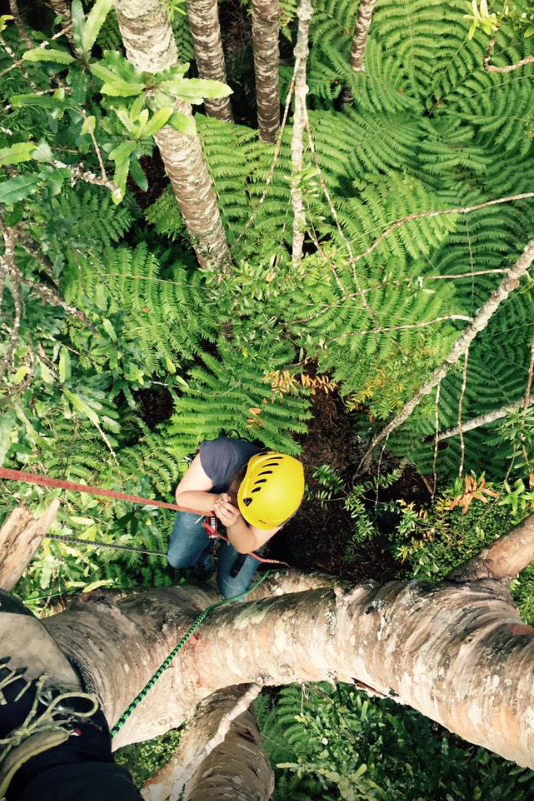
Tall trees, canopy sampling and sap flow sensors at Huapai scientific reserve. Middle photo by Freddie Hjelm from The Living Tree Company

The great loss of water is necessary because at the same time carbon dioxide can diffuse into the leaf where it can be transformed into sugars and subsequently used for growth and maintenance. Water use patterns vary greatly between tree species. Some trees have a greater water use efficiency than others, which means they can gain more carbon while losing less water than other species. Some trees also have very conservative water use patterns, they control their stomata opening and lose less water, but also take up less carbon resulting in slower growth.

On a global scale trees and forested areas play a major role in the hydrological cycle due to transpiration but also because of evaporation of intercepted water. According to estimates, 41,000 cubic km of water are transpired globally every year. This is equivalent to 630 times the water volume of Lake Taupo and strongly influences rainfall patterns and the amount of water vapour (an important greenhouse gas) in the atmosphere. On a more local scale forested areas directly and indirectly influence many fresh water catchments and subsequently the supply and quality of drinking water.

Transpiration is still one of the biggest uncertainties in climate modelling, mainly due to a lack of data and the difficulty of measurement. We also know very little about the water use patterns of New Zealand trees. How much water do they use? How does that vary seasonally and annually? What effects does a rising atmospheric carbon dioxide concentration have on water use and transpiration? And how do changes in other climate variables affect the water use and related physiological processes of trees in New Zealand?

The recent global fascination of plants day highlighted the value and intrigue of plants and trees add an extra dimension to that. My research is exploring the physiology of four native tree species here in New Zealand. Stay tuned for some fascinating results!

Julia Kaplick is a PhD student in the Centre of Biodiversity and Biosecurity, School of Biological Sciences, University of Auckland. She is researching the response of native trees to seasonal variation in climatic conditions using measurements of sap flow, water relations and carbon allocation. Julia is supervised by Cate Macinnis-Ng (University of Auckland) and Mike Clearwater (Waikato University). Julia is supported by funding from the Marsden Fund.  

When natives go wild: New Zealand… a global supplier of invasive species

Stringer UoA photo

Posted by Lloyd Stringer

After reading Mick Clout’s post on New Zealand’s potential as an Ark for non-native species; a source of genetically diverse species, that could be used to repopulate the historically native ranges from whence they came, I got a-thinking… Is New Zealand a source of invasive species?

In my day job I work on ways to prevent adventive species establishment in New Zealand. I was heartened to discover that Aotearoa has been exporting more than vibrant young kiwis on overseas working holidays.

As a kid I dreamed of a never ending Christmas. That has potential to come into fruition with the spread of New Zealand’s Christmas tree, the pohutukawa, Metrosideros excelsa into European countries. Meanwhile, in South Africa, pohutukawa threaten the ecologically unique Fynbos, already under threat from other invasive species, via prolific seed production leading to dense seedling stands.

A Pohutukawa in full bloom. This species typically flowers from Dec-Jan. Credit: by Ed323 at en.wikipedia (Transferred from en.wikipedia) [Public domain], from Wikimedia Common.

A Pohutukawa in full bloom. This species typically flowers from Dec-Jan. Credit: by Ed323 at en.wikipedia (Transferred from en.wikipedia) [Public domain], from Wikimedia Common.

Another successful export has been the Karaka, Corynocarpus laevigatus. This New Zealand treasure provides a risky food requiring days of preparation to detoxify the seeds prior to eating. Karaka were used in reforestation efforts in Hawaii early in 20th century where it now forms dense stands potentially shading out local, rare endemic plant species.

Possibly some of the less iconic New Zealand species making their way around the globe are the mudsnail Potamopyrgus antipodarum and flatworm Arthurdendyus triangulatus. New Zealand’s mudsnail can reach densities of up to 300,000 individuals per square metre in some rivers, modifying ecosystem processes. Whereas on land, the flatworm, predates on earthworms which could lead to secondary effects such as a reduction in soil quality and a reduction of a food source for native birds.

Perhaps what we are seeing are the New Zealand-sourced winners that could have a chance at surviving in a possible future world that is less species–rich, instead dominated by a few widespread species.

IMG_0659
Lloyd Stringer is an invasive species entomologist at Plant & Food Research and doctoral student in the School of Biological Sciences, University of Auckland, investigating the interactions between eradication tools and Allee thresholds.

 He is supervised by Max Suckling, Jacqueline Beggs and John Kean. Here Lloyd is planning a red imported fire ant field experiment.

We need to talk about ALAN

Ellery (2)Posted by Ellery McNaughton @EJ_McNaughton

Like Santa, ALAN probably sees you when you are sleeping. ALAN will be trying to get in through your window tonight. Perhaps you haven’t noticed ALAN. But ALAN is always there. ALAN may be having serious impacts on your health. ALAN kills innocent birds and baby turtles for fun.

ALAN will be following you home tonight... and when you get there, ALAN will already be waiting for you

ALAN will be following you home tonight… and when you get there, ALAN will already be waiting for you

And yet, who doesn’t love ALAN? Who hasn’t invited ALAN into their homes and cities?

Artificial Light At Night (ALAN) is a global issue. If you live in an urban area you cannot escape it. Streets, buildings, sports fields, parks, monuments – all are lit up come night time, and it’s easy to see why. Light enables us to see better, feel safer and do more at night. Plus it looks pretty. Bonus!

Sydney - an example of cities' typical love of ALAN. When has pollution ever looked so fetching?

Sydney – an example of cities’ typical love of ALAN. When has pollution ever looked so fetching?

Light pollution doesn’t get the same attention that water or air pollution does. Perhaps this is because it doesn’t add a physical pollutant to the environment. Perhaps it is because it is seen as transient – once the lights are switched off in the morning, problem solved. Or perhaps it is because we have forgotten what the night sky should look like, so we fail to realise just how polluted our skies are. Whatever the reason, traditionally light pollution has only been an issue of concern among astronomers.

Recently however, there is light on the horizon in addition to light in our skies. There has been a surge of research into the myriad effects of ALAN on the environment (e.g. this special issue in Proc. R. Soc. B). Citizen science is being used to better understand variations in the levels of light pollution. The United Nations proclaimed 2015 to be the International Year of Light and Light-based Technologies, while the Nobel Prize in Physics for 2014 was awarded to the inventors of the blue light-emitting diode. This recent focus on light, light technologies and ALAN in particular opens up opportunities for discussion and thought on these issues. And really, this needs to happen. Because ALAN is most definitely on the naughty list, and we need to talk about it.

Ellery McNaughton is a PhD student in the Centre of Biodiversity and Biosecurity, School of Biological Sciences, University of Auckland. Her project will investigate the effects of a city-wide changeover in streetlight technology on urban bird behaviour and ecosystem function. She is supervised by Margaret Stanley, Jacqueline Beggs, Kevin Gaston (University of Exeter, UK) and Daryl Jones (Griffith University, Australia).