How many exotic invertebrates in New Zealand?

Posted by Darren Ward @nzhymenoptera

New Zealand is well known for its problems with exotic pests and weeds; whether it’s vertebrate predators and their devastating impacts on native birds, vertebrate herbivores chomping through tonnes of native vegetation per night, or weeds out-competing and smothering native species. Relatively speaking we have excellent information on the number of these exotic species, their distributions, densities, and impacts.

But what about exotic invertebrates? How many are there in New Zealand? Apart from a relatively small number of high profile species, the total number of exotic invertebrates species established here is only a ‘best guess’. However, generating such information is an important part of studying invasion biology, particularly when such information is compared and contrasted with other parts of the world.

Hymenoptera are a massively diverse Order of insects, including bees, ants, wasps, and parasitoids. Humans have a love/hate relationship with Hymenoptera. They can be pollinators of economically important crops and of native plants, and have widespread application as biological control agents for the control of insect pests. However, when they are bad, they are horrid. Invasive ants, social wasps, sawflies, woodwasps, and gall wasps, all cause huge economic, social, and environmental problems in different places around the world.

Asian Paper Wasp -small.jpg

Asian Paper wasp on nest in Auckland.


Recently, we completed the first inventory of all exotic Hymenoptera in New Zealand, and made comparisons to a large European database (DAISIE, Delivering Alien Invasive Species Inventories for Europe).  We found several interesting trends.

  • Over 300 species are established in New Zealand, more than in Europe (334 vs 286). The European fauna also had a much higher proportion of intentional releases (i.e. biocontrol, pollination), further highlighting the large number of unintentional establishments for New Zealand.
  • Also strikingly was the ‘disharmonic island’ nature of New Zealand. One third of the taxonomic families in New Zealand have no native species, and are only present as exotic representatives, including common taxa such as honeybees, bumblebees (Apidae), and social wasps (Vespidae).
  • We also found a change in the origins of exotic species establishing over time, with an increasing dominance of species from Australia during the past 25 years.

Our project shows the importance of examining large-scale datasets of multiple species over long-periods. It also shows the importance of scientific collections – where much of this information was obtained.

Darren Ward is an entomologist in the New Zealand Arthropod Collection at Landcare Research, and a senior lecturer at the School of Biological Sciences, University of Auckland. More detail: Ward DF, Edney-Browne E. 2015. Poles apart: comparing trends of alien Hymenoptera in New Zealand with Europe (DAISIE). Plos One. 10.1371/journal.pone.0132264

 

The cow in the room

Posted by Alice Baranyovits @ABaranyovits

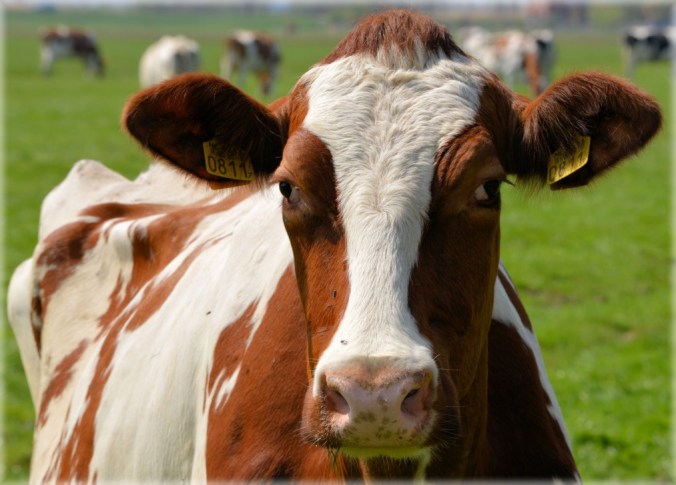
CowLast week the Royal Society of New Zealand launched their report on options for climate change mitigation for New Zealand entitled ‘Transition to a Low-Carbon Economy for New Zealand’. As part of the launch they released several infographics including a panel on what immediate actions individuals can make to reduce their carbon footprint. These included increased use of public transport and cycling, planting trees, using energy efficient appliances and reducing the frequency of air travel. Whilst these are all important and worthwhile actions, I feel that there is one obvious oversight, one big elephant, or more accurately in this case, cow in the room and that’s that there is no mention on this infographic for the need to reduce meat and dairy consumption.

Now in order to be fully transparent…I’ll admit I’m a vegan and as my friends and family will attest, for someone who doesn’t eat any meat or dairy I do seem to spend quite some time talking about it. But while I’ll try to avoid climbing onto the soapbox for this one, I do feel that meat consumption is something that needs to and should be discussed.

New Zealanders it seems, like their meat. NZ is often listed as one of the most carnivorous countries in the world, with annual meat consumption frequently quoted as being greater than 100 kg per person (with one estimate at a super-sized 126 kg), putting it well above the global average of 42 kg per year – according to this chart from the Economist, New Zealanders are the 4th biggest meat consumers in the world!

Like many other developed countries, New Zealand’s meat consumption has remained fairly steady and is predicted to remain at similar levels for the coming decades. Globally however, it’s a different story. The demand for meat is growing, linked with increasing wealth and urbanisation of many developing countries. This increase in demand combined with rapid human population growth has seen meat production grow from around 70 million tonnes in 1961 to a huge 278 million tonnes in 2009, with further increases up to a whopping 460 million tonnes predicted by 2050. Now that is a lot of meat.

The stated contribution of livestock production to current global greenhouse gas (GHG) emissions varies from around 10 to 25% (depending on whether emissions due to deforestation and land use change associated with pasture creation are included). But the regularly quoted FAO’s statistic of 14.5%, would put livestock production on par with the emissions contributed by the global transport sector. In NZ, agriculture contributors almost half (47% in 2010) of the country’s GHG emissions, 95% of which come from the pastoral system. On top of this, livestock production has various other substantial environmental impacts, such as high water use, groundwater contamination and biodiversity loss (summarised nicely here).

Ways to mitigate these GHGs are often described in two parts; reducing emissions during production (see here for more examples) and reducing demand. The Royal Society’s report contains multiple potential technical options that could be used to help reduce production related emissions, such as increasing farm efficiency, developing methane inhibitors and selectively breeding lower-emission animals.  However, although these technologies may decrease emission intensity, they are unlikely to limit overall emissions if total production continues to grow.

So how about reducing demand? A global shift to a more plant-based diet, much lower in animal protein than the current average diet in developed countries, has been repeatedly suggested by the UN and others, as one practical way to tackle not only GHGs, but other environmental issues associated with human food production (see the end of the post for some links). For example, in their Fifth Assessment Report the IPCC stated that global dietary change could have a substantial impact on agriculture’s GHG emissions, with a potential saving of 0.7-7.3Gt CO2-eq/yr in 2050. Additionally, a recent study by Springmann et al. (2016) reported that a global move towards a low-meat diet, which limited red meat intake to 300g a week, would reduce the predicted 2050 food-related emissions by 29%. If people went further and shifted to a fully vegetarian or vegan diet then they predicted that the food-related emissions would be decreased by 63 and 70% respectively.

Now I’m certainly not suggesting that everyone goes vegan, I understand and appreciate that there are many people that rely on the meat and dairy industry for their livelihoods, as well as the fact that many people simply enjoy eating burgers, sausages and cheese. But this isn’t about stopping eating meat but rather reducing how much and what type (beef, for example produces more emissions per kg of protein than poultry).

And yes I know that New Zealand exports much of the meat (83% of beef) and dairy (95%) it produces, so a reduction in domestic demand in New Zealand will have less impact than in a country that consumes most of its own meat. However, that doesn’t mean that we shouldn’t act.  Changing your diet isn’t going to ‘solve’ climate change, but it is one of the easiest ways individuals can help reduce their own environmental impact.   It’s time to start talking about the cow in the room.  So, anyone for a veggie burger?

Further Reading:


ABAlice Baranyovits is a PhD student at the Centre of Biodiversity and Biosecurity, School of Biological Sciences, University of Auckland. She is researching the movements of kererū in urban areas. She is supervised by Jacqueline Beggs, Mick Clout, Todd Dennis & George Perry.

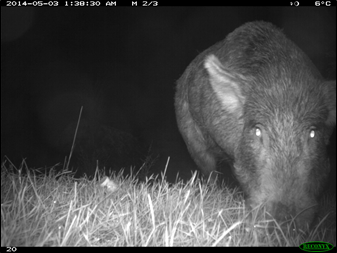
New Zealand’s pig problem!

This blog is re-blogged from “Kapow! Ecology” and is based on one of Ecology Ngātahi’s publications:

Krull CR, Stanley MC, Burns BR, Etherington TR, Choquenot D. 2016. Reducing Wildlife Damage with Cost-Effective Management Programmes. PLoS One DOI: 10.1371/journal.pone.0146765


Luke O'Loughlin's avatarKAPOW! ECOLOGY

It’s a story about pigs and takin’ money – get down girl, go ahead get down… And this is all going down across the Tasman; are you picking up their problem??

View original post 313 more words

Getting involved – local science outreach

Posted by Anna Frances Probert @AFProbert

I have recently had the opportunity to go and spend the day with school children as part of science engagement programmes. On one occasion, it was down to the wetlands with the local primary school where myself and Jamie Stavert went out with the students looking at the local biodiversity, armed with a few nets, an aspirator and some pottles. More recently, on another occasion Jamie and I also went down to Palmerston North to spend the day with high school students on the Indigenous Sparks programmeTM, organised through the PTC trust. The aim of the programme is to engage young Māori students with the sciences, who are traditionally underrepresented in the STEM subjects, and particularly so at the post-graduate level.

blog 3 photo

Looking at the local fresh water invertebrate community

On both occasions, it was incredibly obvious that the hands-on approach of getting students out of the classroom and into the field sparks that curiosity by giving students something tangible to engage with. Arm a kid with a net and challenge them to catch an invertebrate and chances are you’ll have trove of pottles filled with various specimens in no time. Make students sit down and listen to you talk for 15 minutes about science and chances are you’ll have bored them all to death.

A_butterfly_chase_(1869)_(14775597553)

A butterfly chase (1869) Source: Wiki Commons

Unfortunately, for many schools, funding cuts and a general lack of resources mean that schools are having to drop field trips. This isn’t good news for inspiring the next generation of scientists. Although there are many amazing scientific experiments that can be conducted by anyone, anywhere (see Nanogirl’s 100 days Project for some neat ideas), it would be great to see more science-engagement for schools from universities.

There are already some amazing people involved with science engagement initiatives with schools at a local and national scale. However, I’m sure there are many other people who could get involved. Plus, it’s really fun and gets you out the office for the day. The only downside is that it makes you realise how old you are.

The PTC trust is a not-for-profit organisation that relies on the support from tertiary institutes/academics/students to further their Indigenous Sparks™ programme across schools in New Zealand. Please contact them if you are interested in getting involved (ptctrustinfo@gmail.com).

Anna Probert is a PhD student in the Centre for Biodiversity & Biosecurity, School of Biological Sciences, University of Auckland. She is using ants as a model to assess the risk posed by exotic invertebrates to native ecosystems. She is supervised by Margaret Stanley, Jacqueline Beggs, and Darren Ward.


The accidental trade in unwanted organisms

Posted by Delayn Fritz @WildOptic

Progress and technological advancement allows us the brilliant capability to receive goods from the other side of the planet in only a matter of days. This is a good thing for the delivery men who just 100 years ago would have had to suffer an arduous journey just for the yearly supply of salt. However, this decrease in vectoring time has meant that survivorship of stowaway critters has increased, as well as an overall increase in the amount of trade volume. In fact, it has been shown that the amount of trade may be the biggest indicator of how many invasive species are established in a given country, and this trade has steadily been increasing.

So this may leave you wondering how do species become invasive, and move from the initial ’transport stage’ and proliferate into an invasive species. A unified framework for this process has been widely accepted and explains several stages from transportation, to establishment, to spread. This is important because between each stage are biological barriers that may inhibit species from moving to the next stage. Species can overcome these barriers, through increased propagule pressure (i.e. the amount of individuals being introduced), by being pre-adapted to the climate of the new environment, and perhaps by possessing certain biological characteristics.

The unified framework proposed by Blackburn et al. 2011

Why should we care about the process and not just focus on eradication? The associated effort and cost to remove a species increases as it occupies more area. The fruit fly incursion responses in 2012 and 2014 both cost around $2 million, and that was just the size of a suburb. The real goal and money saver while getting the best results would be to prevent a species from establishing and/or spreading in the first place, this is best done in conjunction with understanding the invasion pathway and bolstering the natural barriers that already exist.

The invasion curve refined by Harvey and Mazzotti

This is where my MSc project comes in. I am studying a data set spanning 60 years of interception data at the border, and records of spread within New Zealand to try and understand the reasons that non-native ant species have either been successful in establishing and spreading or why they have failed. In starting to really understand how these barriers affect success of species we can improve chances of successful prevention through risk assessment.

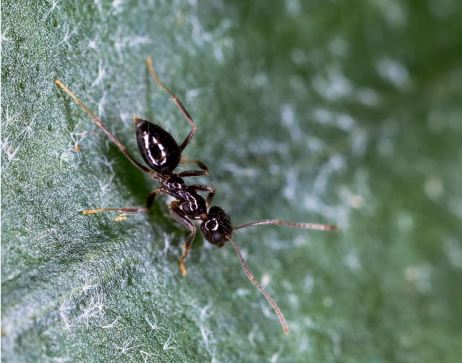
Nylanderia spp. in the urban garden (Image credit: Delayn Fritz)

Nylanderia spp. in the urban garden (Image credit: Delayn Fritz)

delayn.JPG Delayn Fritz is an MSc student in the Centre of Biodiversity  and Biosecurity, School of Biological Sciences, University of Auckland. He is interested in the invasion process of ants (Hymenoptera: Formicidae) in New Zealand. He is supervised by Darren Ward and Eckehard Brockerhoff (Scion, B3).


Pushing the reset button on nature’s alarm clocks

Posted by Ellery McNaughton @EJ_McNaughton

Sunrise_red-yellow_glow

Some birds don’t seem to care that dawn frequently looks nicer than it feels

I struggled in achieving the Herculean feat of getting up before dawn today. Fortunately for me, I had help – my local tūī (Prosthemadera novaeseelandiae) decided to serenade the neighbourhood, a sound far more pleasant than the alarm on my phone. Not everyone is so appreciative, especially when the ‘dawn chorus’ begins well before its name would suggest.

Timing of dawn song is influenced by a number of natural factors. For example, studies have shown that rain, noise from nocturnal insects, intensity of moonlight, and even individual personality can advance or delay the onset of dawn song. Of course, factors such as noise and light intensity can also be introduced into the environment as a result of human impact and urbanisation.

The onset of dawn song has been found to be much earlier for urban birds than for their rural counterparts, a difference attributable to traffic noise and artificial light at night (ALAN).

Singing tui

Snooze button nowhere to be found. Photo credit: Tony Wills

Urban birds have been found to sing earlier in the morning when exposed to traffic noise. And it’s not just road vehicles – birds near airports also advance their singing to avoid peak aircraft traffic in the morning. ALAN has also been linked to advancing morning bird song. There are many sources of urban ALAN, but a large proportion comes from streetlights. The effects of different types of streetlights on the timing of urban bird song is not yet fully understood, although there have been some indications that different technologies can have varying effects on different species.

This is the area that I’m interested in for my research. I hope to determine whether changing the streetlights from orange (high-pressure sodium) lights to white (light emitting diode) lights makes my local alarm clock start serenading earlier or later in the morning. Coincidentally, I am also forever grateful to the inventors of audio recorders for enabling bleary-eyed ecologists to sleep through their data collection.

Ellery McNaughton is a PhD student in the Centre of Biodiversity and Biosecurity, School of Biological Sciences, University of Auckland. Her project will investigate the effects of a city-wide changeover in streetlight technology on urban bird behaviour and ecosystem function. She is supervised by Margaret Stanley, Jacqueline Beggs, Kevin Gaston(University of Exeter, UK) and Darryl Jones (Griffith University, Australia).
Native Bees…What’s the buzz?

Did you know that there are 27 species of native bees in New Zealand that are found nowhere else in the world? If your answer to this question was ‘no’, don’t worry – you are not alone! While most people are familiar with the ‘honey bee’ and ‘bumblebees’ (species that have been purposefully introduced to New Zealand to improve the pollination of crops), native bees often go unnoticed.

Most native bees in New Zealand are solitary and nest in the ground. All native bees consume pollen and nectar, and have similar life cycles. Female bees construct the nests in which their young are raised by digging blind-tunnels in the soil or using pre-existing tunnels in plant material. Each nest contains a cell in which the female bees place all the food that their larvae will need. They then deposit an egg and seal the cell to avoid contact with that part of the nest until the new bee has developed. Male bees on the other hand spend most their time feeding, mating and resting.

IMG_1514

Native ground-nesting bees mating (photo by Anna Kokeny).

During the active flight season (mid-spring to early autumn), thousands of individuals nest alongside each other, forming large communities. By the end of autumn, adult bees die but the larvae overwinter until they emerge in mid-spring and the cycle repeats!

IMG_1521 (3)

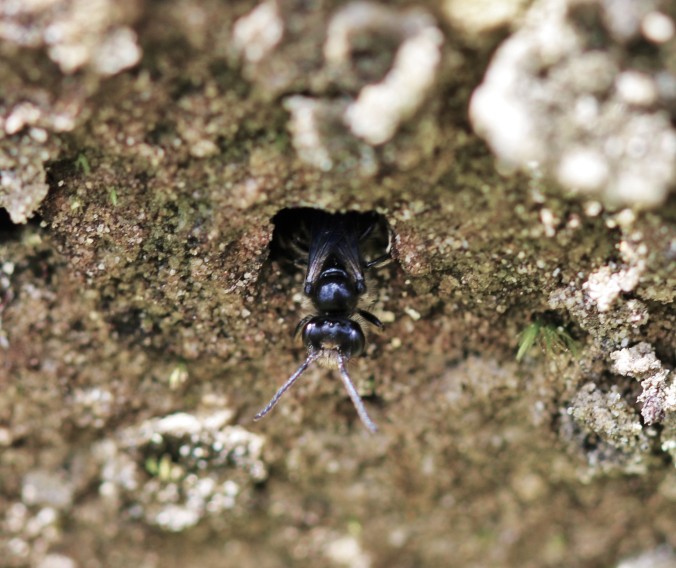
Native ground-nesting bee emerging from its nest (photo by Anna Kokeny).


Studying native bees can be difficult as there are few ways to easily monitor them. As a result, there is much to learn about their populations, diversity and distribution throughout New Zealand. The aim of my master’s project is to investigate how soil characteristics influence the distribution of solitary-ground nesting bees in the Waikato and Northland region. In order to do this, I am analysing soil samples collected from sites with native bees and sites without native bees and comparing this to the abundance and diversity of native bees. Already, my summer sampling has revealed that the most common species of native bee within those regions are Leioproctus paahaumaa and L. imitatus.

IMG_2435

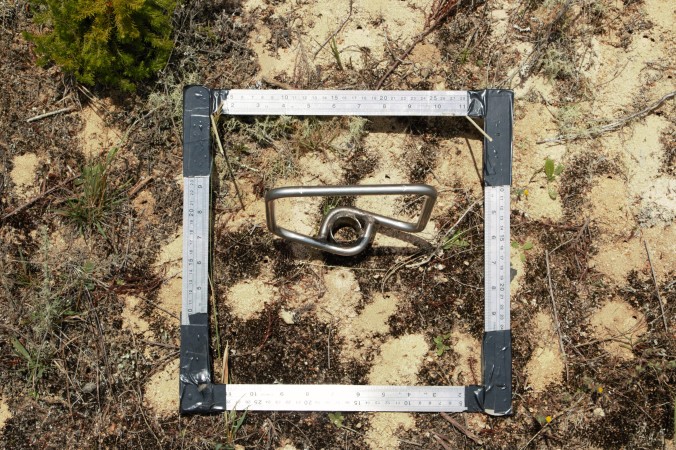
Collecting soil sample from a native bee nest site using a soil corer (photo by Anna Kokeny).

The two most frequently asked questions I’ve encountered whilst collecting data were: “do they make honey?” and “do they sting?” No, native bees do not produce honey and will very rarely sting humans. So, why should we care about them? Native bees are key pollinators of New Zealand’s native flora. They are known to pollinate a wide range of plants including mānuka, kānuka and pohutukawa.

IMG_2255 (44)

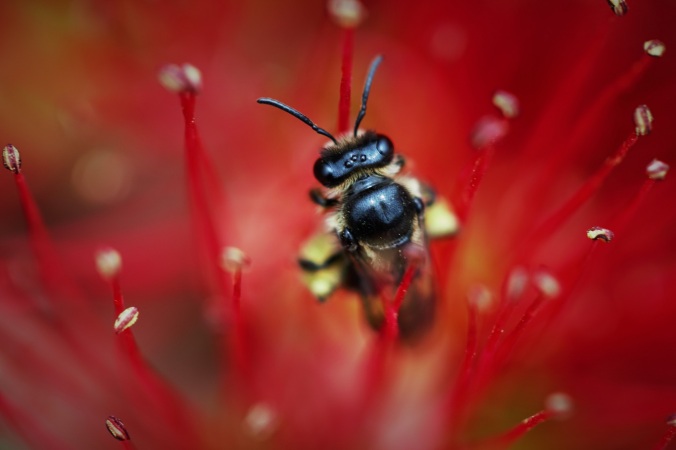
Native ground-nesting bee laden with pohutukawa pollen (background yellow colour)(photo by Anna Kokeny).

IMG_1814 (2)

Native bee foraging on manuka flower (photo by Anna Kokeny).

Also, surprisingly Leioproctus bees can open a mistletoe flower (Peraxilla tetrapetala) by biting the tip of the bud. The main pollinators of mistletoe are bellbirds and tūī, but since introduced pests have significantly reduced bird numbers, native bees have partially replaced them as pollinators (Robertson et al., 2005).

 Get involved

To find out more about native bees join this Facebook group. This page is dedicated to NZ native bees – what they look like, where they live, what they do and how we can support them.

IMG_0384 (4)

Anna Kokeny is a MSc student in the Centre of Biodiversity and Biosecurity, School of Biological Sciences, University of Auckland. She is interested in the distribution of native solitary ground nesting bees in the Waikato and Northland regions. She is supervised by Jacqueline Beggs, Jamie Stavert, Anne Gaskett and David Pattermore (Plant and Food Research).


Play time – Scientific toys

Posted by Julia Kaplick @julekap

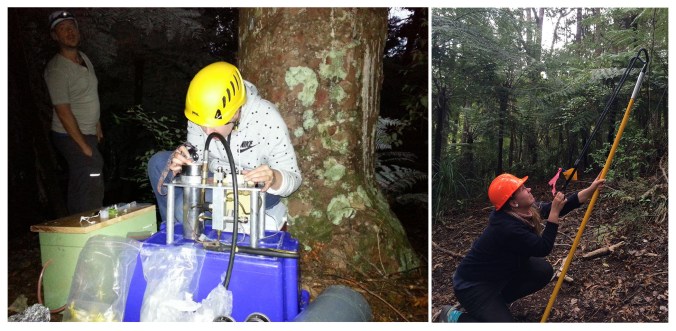
My research focuses on trees, but when I look at the equipment I fill my car with when I go out to my field site, it looks more like I am an electrician. There are car batteries, cables, a bag full of tools, a laptop and lots more. Only a field notebook to record observations like Darwin or Humboldt have done it, is just not enough anymore. Nowadays most research involves specialised equipment to gather data or samples and advanced technology to physically or chemically analyse all sorts of sample materials. That can be daunting, but mostly it is just great to have so many toys to play with as a researcher.

kauri sapflow

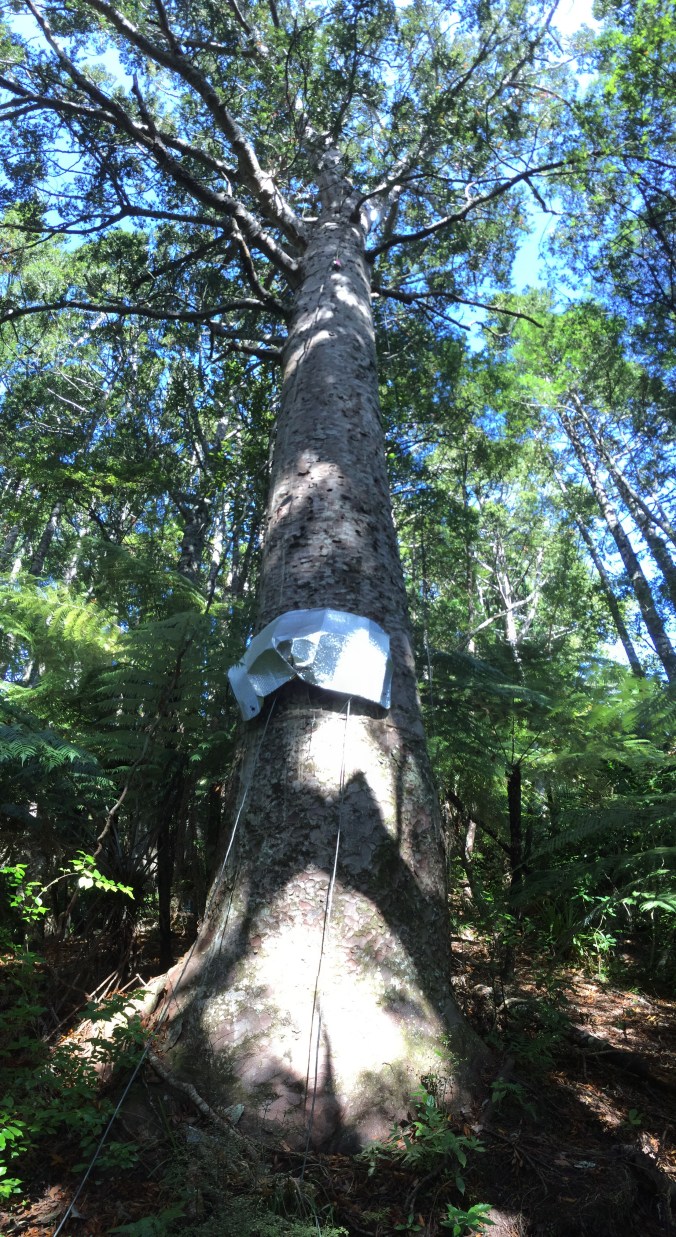
Kauri tree with sap flow sensor – nicely wrapped (for sun protection) like toys for christmas

I rely on sensors to gather most of my data. A meteorological station records environmental data for me, sap flow sensors (that I partly built myself) measure how much water my trees are using and I use a little thing called Trephor to collect wood samples (see how in this little video). The newest additions to our toy collection are called radius dendrometers. They will very soon record the expansion and contraction of my study trees’ stems on an extremely fine scale. That will give me an idea about daily patterns of water storage and growth. When the parcel with that equipment arrived I was excited like a little child at Christmas, but very soon the daunting part started. I needed to figure out how to get them working, how to install them and there is always that little bit of anxiety, because all that equipment is ridiculously expensive since it is so specialised and only few people in the world use it.

thetoys

Some of the toys I get to play with: Trephor micro corer to collect wood samples, our meteorological station, sap flow sensors (that is how it looks like under the wrapping paper) and data loggers to record measurements (with lots of fun coloured cables)

All these toys are great and playing with them is mostly fun, the harder part is the interpretation of the data they gather. Even though there have been many advances in how to get data the part where you have to make sense out of it to generate knowledge has not actually changed much since Darwin and Humboldt.

girlswithtoys

#girlswithtoys, specifically #ecologytoys: Measuring water potential with a pressure bomb and (attempt to) shooting down leaves

To have a look at some cool toys scientists are using check out #girlswithtoys on twitter.

photo_julia

Julia Kaplick is a PhD student in the Centre of Biodiversity and Biosecurity, School of Biological Sciences, University of Auckland. She is researching the response of native trees to seasonal variation in climatic conditions using measurements of sap flow, water relations and carbon allocation. Julia is supervised by Cate Macinnis-Ng (University of Auckland) and Mike Clearwater (Waikato University). Julia is supported by funding from the Marsden Fund.  

Why do I care about conservation?

Posted by Samantha Lincoln @slin247

With the increasing prevalence of technology and social media, and the ability to widely disperse information, I find myself asking why I have followed a path of research and conservation. Is it with the aim of publishing in the most prestigious journals to add gold stars to my CV, or because the academic community is the most effective place to disperse knowledge? This is a question I’m yet to answer, but as my career progresses public interaction seems to be where I personally can make the greatest difference. I have always wanted to give a voice to those who cannot speak for themselves and help our native species which have been under threat for so long. This blog is but one way members of Ecology Ngatahi are able to share our knowledge on a public platform; I encourage others to take a moment to remember why they do what they do and how best to truly make a positive impact in their environment.

Over the year of my Masters focussing on domestic cats (Felis catus) in urban habitats, I have found myself repeatedly compared to Gareth Morgan in a negative light. His outspoken opinions on the negative impacts of cats in Aotearoa have often isolated people from important discussions due to his cold assessment of cats, however it has also brought an important issue into public discussions. Many argue that pet cats have positive impacts due to their predation of mice and rats, and that they only prey upon common birds, and ‘my Fluffy isn’t a hunter’ – the list goes on. But there is unequivocal proof that cats do have negative impacts upon our native species, and that what cat owners see is not representative of their beloved’s total kill count. A US study found less than a quarter of kills were returned home. Rodents are still present at high levels in our urban parks despite cats. I caught 131 ship rats (Rattus rattus) and 7 Norway rats (Rattus norvegicus) over just five nights (1255 corrected trap nights) at eight urban Auckland bush fragments, at sites with plenty of cat activity.

Pic1

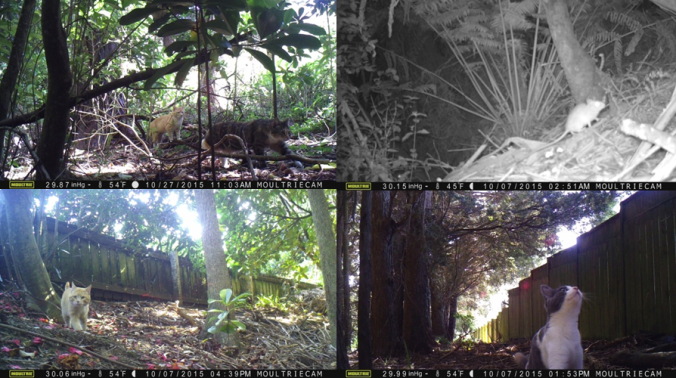
Clockwise from top left: a cat duo on the prowl at Walpole Reserve, a rat visiting Arch Hill Reserve a few hours after a cat passed through, a cat visiting Peretao Reserve, and another cat at Walpole Reserve. Source: Moultrie 990i cameras; Sam Lincoln.

Ecology can be a tangle, which is why single species control for pest management can lack luster compared to more comprehensive programmes. Large scale projects with generous community input like Cape to City are a great way to inspire and educate the public; putting academic findings to practice while encouraging future generations of scientists. We need to continue open discourse regarding pest management of all pest species, treating ecosystems as integrated systems which won’t be fixed by single species control. As scientists, it is our responsibility to ensure relevant information is made available to the public in a readily consumable format to dispel misinformation and encourage active conservation.

Despite some of our pest species being adorable, we must act to save our natives.

Pic2

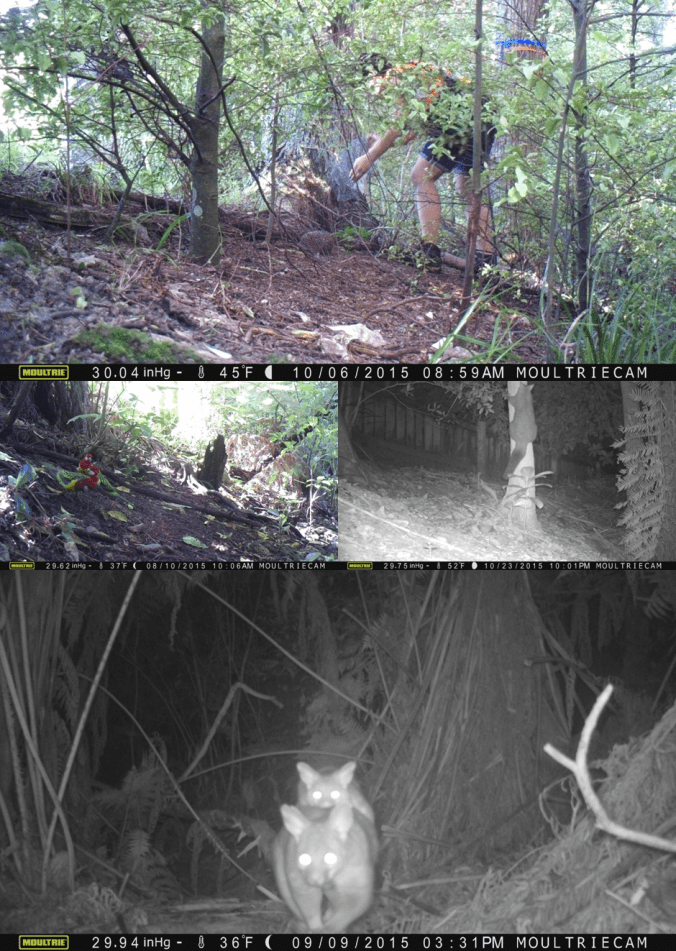
From top: a hedgehog (Erinaceus europaeus)  being released from a live capture trap at Peretao Reserve, a party of Eastern Rosellas (Platycercus eximius) at Gretel Reserve, a tree-hugging possum (Thrichosurus vulpecula) at Walpole Reserve, and a possum family photo from Sunnynook Reserve. Source: Moultrie 990i cameras; Sam Lincoln


Sam Ln webSam Lincoln is an MSc student in the Centre for Biodiversity & Biosecurity, School of Biological Sciences, University of  Auckland. She is trying to disentangle interactions between domestic cats and rats in urban environments. She is supervised by Margaret Stanley, John Innes and Al Glen.


The Science & The Art of Camera-Trapping

Posted by Robert Vennell @RobertVennell

From the very beginning, camera trap images have fascinated us.  In the 1890’s George Shiras III – “Grandfather Flash” – developed the first true camera-traps using trip wires and animal lures. When an animal triggered the wire it activated a magnesium flash gun that detonated in a blinding explosion of light that sent animals scattering in all directions. The images he captured were the first night-time wildlife photos ever created and revealed eerie snapshots of a hidden world.

George Shiras III - Camera Trap Photos

George Shiras III “Grandfather Flash” (top left) used a system of trip wires to capture animal photos as early as the 1890s. Source: National Geographic

In the past few decades camera traps have undergone a revolution as a scientific monitoring tool and advances in technology along with a huge reduction in price have led to an explosion in camera trap research. And yet camera traps remain unique as a monitoring tool as they not only collect valuable data, but they produce fascinating images that retain their power to amaze and inspire.

In this way, camera traps represent a unique blending of science and art. They allow us to investigate the natural world, but also package and present it in an engaging way. Raw data has never looked so delicious and interesting; arriving pre-wrapped in shiny packaging, immediately ready for consumption.

Raw data has never looked so delicious and interesting”

As such, camera-traps offer us a monumental opportunity for science communication. Anyone can immediately appreciate and understand the data – allowing us to bridge the gap between ‘experts’ and the public, and open up a dialogue about a range of different issues.

Wildlife Camera Trap Photo of The Year - BBC

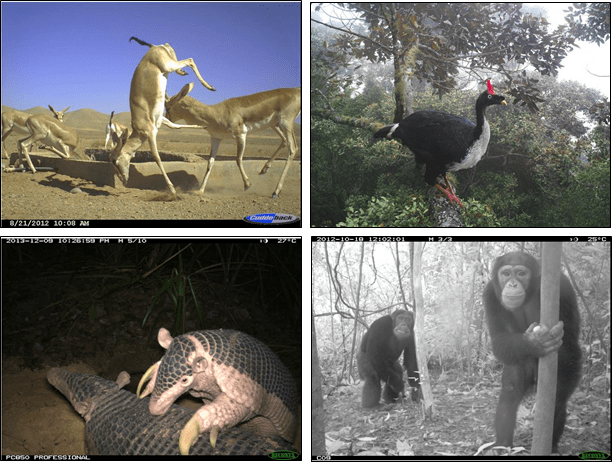
Commended photos from the BBC Wildlife Photo of the Year Competition. Top left: Goitered gazelles by the Iranian Cheetah Society. Top right: Horned guan by Javier Rivas. Bottom left: Baby giant armadillo playing by Pantanal Giant Armadillo Project. Bottom right: Chimpanzees by ARTP and GRNP.

However, with such a unique opportunity it is important that we don’t get carried away with the art and forget about the science. It’s very easy to collect camera trap data – the hard part is knowing what to do with the data. What do the images of animals we collect actually mean? Do they simply provide evidence that a species exists in an area, or can we use them to ask deeper questions about whether or not our conservation actions are working?

“What do the images of animals we collect actually mean?”

This brings us to my research topic this year. I’m going to be studying feral pigs and the damage they cause to native forests by rooting up the undergrowth. I’ll be using camera-traps to monitor the abundance of feral pig populations – and will undoubtedly collect a vast amount of fascinating pictures. But I want those pictures to be as meaningful as possible.

Feral Pig, Hawkes Bay - Patrick Garvey

Feral pig in Hawkes Bay, New Zealand. Source: Patrick Garvey

In New Zealand conservation, the overwhelming majority of monitoring funding goes towards results-based monitoring – a “how many pigs did we kill?” mentality that doesn’t answer the more fundamental question of “did killing all those pigs actually achieve our goals?”.

What I hope to do is create a damage function that links the number of pigs on the cameras with the damage they cause to the environment. This should help managers around the country set meaningful targets for pig control that will help protect and restore native forests.

That’s the scientific message that I really want to communicate with my research, and luckily for me I’m going to be armed with arsenal of tasty visual treats to help me do it. I’ll be sure to share them with you as I go.

Robert Vennell - UOA.jpgRobert Vennell is an MSc student in the Centre of Biodiversity and Biosecurity, School of Biological Sciences, University of Auckland. He is supervised by Margaret Stanley, Mark Mitchell (Auckland Council), Cheryl Krull (AUT) and Al Glen (Landcare Research). He also writes about the history, meaning and significance of New Zealand’s native tree species at www.meaningoftrees.com