Posted by Rebecca Lehrke @rmlehrke
It would be pretty catastrophic – albeit unlikely – for a fire to sweep through your lab destroying all your research with it. On the other hand, forgetting to save the paper you are working on and so losing the last few hours of productivity, though slightly less painful, probably happens quite frequently to the best of us. Both events carry risks and have the potential of occurring. So which event is more important to prepare for or could collaboration remove the need to decide?
Understanding the balance between the probability of an event occurring and its consequence is important when managing wildlife. Take my current research topic for example – bird strike by black swans. Sparrows hit planes on a daily basis, but their impacts are usually minimal. Black swans on the other hand rarely hit planes. The difference is, when a black swan hits a plane the impact is equivalent to a Holden Commodore VE Sedan hitting a brick wall at least 15km per hour. This kind of impact can destroy a plane’s nose cone costing over $25,000, let alone the risks if it enters an engine. So what event should we be most concerned about?
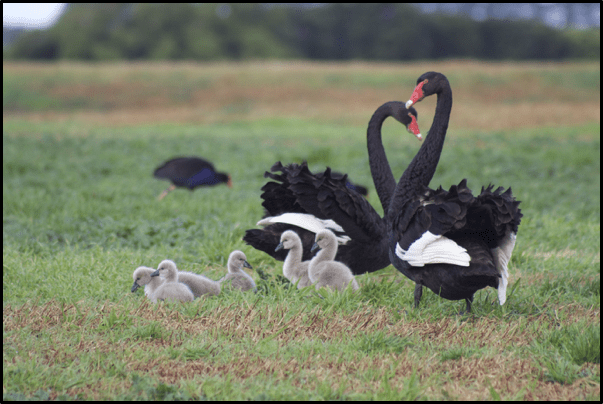
Black swan (Cygnus atratus) pair with cygnets at Ambury Regional Park, Auckland.
Unfortunately, there usually aren’t simple answers to balancing risks, and in conservation biology, the survival of a species could be on the line. If we ignore high-risk but low-probability events an endangered species could go extinct because a 100-year storm event wipes out the last breeding pairs on an island. On the other hand, ignoring day-to-day impacts of resource supply could also lead to its extinction over time.
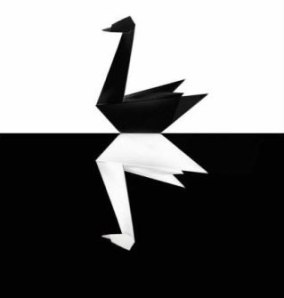
“The Black swan: The impact of the highly improbable” book cover.1
Economics has a long-standing concept that conservation and biosecurity managers could be using in these situations – Black Swan theory. According to Taleb ‘Black Swans’ are events that are unexpected, high impact and can often be explained or predicted in hindsight. Just like that 100-year storm event. Taleb warns that we could waste a lot of time – and money – trying to predict all these ‘Black Swans’. Instead our management plans should be robust enough to mitigate the negative impacts of unexpected events.
Although examples of such contingency plans being used in management programmes exist, it is often on an ad-hoc basis. This is where collaboration and synthesis across disciplines comes in. A devastating 100-year storm may not be common but if you know it is a natural part of the system, you can reduce its impacts, whether that means splitting your population across multiple islands or some other contingency plan.
As ecologists and managers we should always be discussing our study systems with our peers in different disciplines. As Taleb puts it, what the turkey may not see coming the butcher probably does. So let’s be the butcher not the turkey! Get another perspective, share knowledge and collaborate more often. It may not prevent a fire from sweeping through your lab, but seeing your lab from a fireman’s perspective might help you ‘identify’ these risks so you can ‘mitigate’ them by backing up off-site more often. Thus reducing the impacts and “turning the Black Swan white”1.
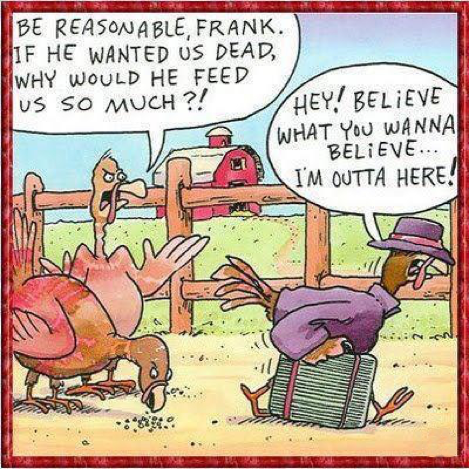
Being the butcher, not the turkey. Retrieved from: http://bit.ly/1pn1vte

Rebecca Lehrke is an MSc student in the Centre for Biodiversity & Biosecurity, School of Biological Sciences, University of Auckland. She is using movement ecology to assess the efficacy of disturbance-based management of black swans at the Auckland Airport. She is supervised by Todd Dennis and Margaret Stanley.
- Taleb, Nassim Nicholas (2007), The Black Swan: The Impact of the Highly Improbable, Random House, ISBN978-1400063512

 Josie Galbraith

 Carolina Lara M


 Dr Cheryl Krull
 House sparrow (Image source: Fir0002/Flagstaffotos)
 Silvereye (Image source: Fir0002/Flagstaffotos)


![medium[1]](https://aucklandecology.com/wp-content/uploads/2016/01/medium1.jpg?w=655&h=491)
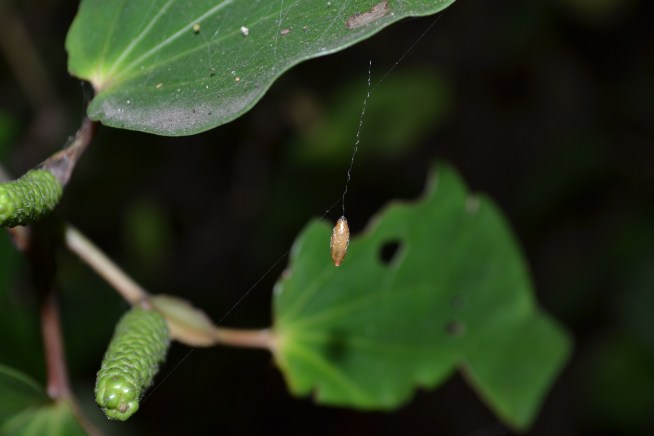



 Digital replacement of nature: There is a risk that nature in cities could be replaced with digital equivalents of nature, such as images and sound recordings. This gives people some of the benefits of nature, but without the maintenance and messy side of nature, however it could lead to city dwellers undervaluing nature in their immediate environment.
 Spread of disease by urban cats: Globally, there are now more than 600 million pet cats, and the increase in pet cat ownership is resulting in the disease toxoplasma spilling over into wildlife populations, in urban areas as well as to species in more remote locations, such as the endangered Hector’s dolphin.
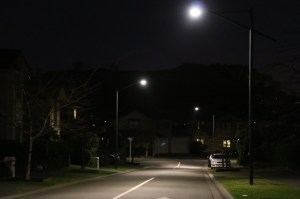 Switch to LED lights: Cities across the globe are switching their lighting technology to LED lights. However, the whiter spectrum of LED lights overlaps with the visual systems of wildlife and can disrupt their physiology and behaviour.
 Self-healing concrete: This is a new concrete product infused with specialised bacteria is about to be commercialised. If use of this product becomes widespread, it could spell the end for the often unique biodiversity that currently manages to thrive in cracked concrete all around cities.
 Ecology Ngātahi